Contents
You are looking for an SEO consultant or agency, and you wonder whether the person in front of you really knows what they are doing? Good question. In France, the SEO market is full of people who sell a lot of talk and very few results.
In this article, I explain why skill levels are so uneven here, where the impostors hide, and which signs should make you walk away before you sign.
In France, the level of SEO is low (and that is no accident)
Let's be honest: compared with the United States or Australia, the average level of SEO in France is low. It is not only a matter of talent, it is mostly a matter of competition.
The English-speaking market is the whole world's playground. A German, Polish, Brazilian or Indian company that wants to grow internationally will target English first. French rarely tops the list.
Yet French is not a small language. According to the OIF's 2026 report, it has 396 million speakers, making it the 4th most spoken language in the world. It is spoken in France, Belgium, Switzerland, Luxembourg, Quebec, across much of West and Central Africa, and it remains widely used in North Africa.
But far fewer companies fight over French-language queries. As a result, you can rank with work that would not last a week on the US market. And when the bar is low, many "experts" never learn to jump high.
Local SEO, the perfect hideout for impostors
When you are not very good at SEO, there is a comfortable niche: local SEO. The recipe has four steps:
- Create a Google Business Profile and fill it in with ChatGPT.
- Get two or three backlinks from local websites.
- Write two articles a month.
- Bill the whole thing €500 a month.
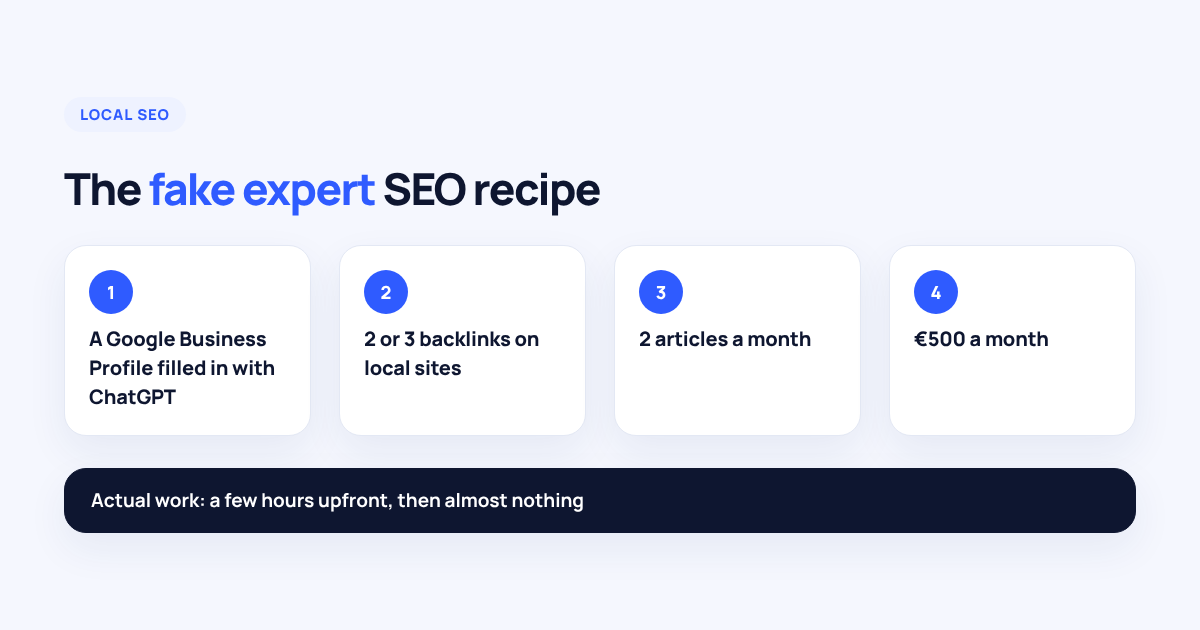 A few hours of work upfront, then almost nothing, billed €500 every month
The client sees their listing show up on Google Maps, they are happy, and the consultant has an easy life. Except this work takes a few hours at the start, then almost nothing.
I will be blunt: if someone calls themselves a "local SEO expert", there is a good chance they are an impostor. There are exceptions, but this specialty mostly attracts people running away from real competition.
Where the real experts are: software and e-commerce
The real SEO competition happens in software (SaaS) and e-commerce. Industry also demands skill, but the best people mostly head for these two sectors, because that is where the best salaries are.
In these markets, a ranking won on a query turns directly into subscriptions or sales. So companies pay a lot for people who can win it.
In the United States, the gaps are dizzying. On Levels.fyi, the top 10% of SEOs report more than $195,000 a year, including stock and bonus. In France, the median salary of an SEO consultant is around €44,500 gross per year, according to Michael Page.
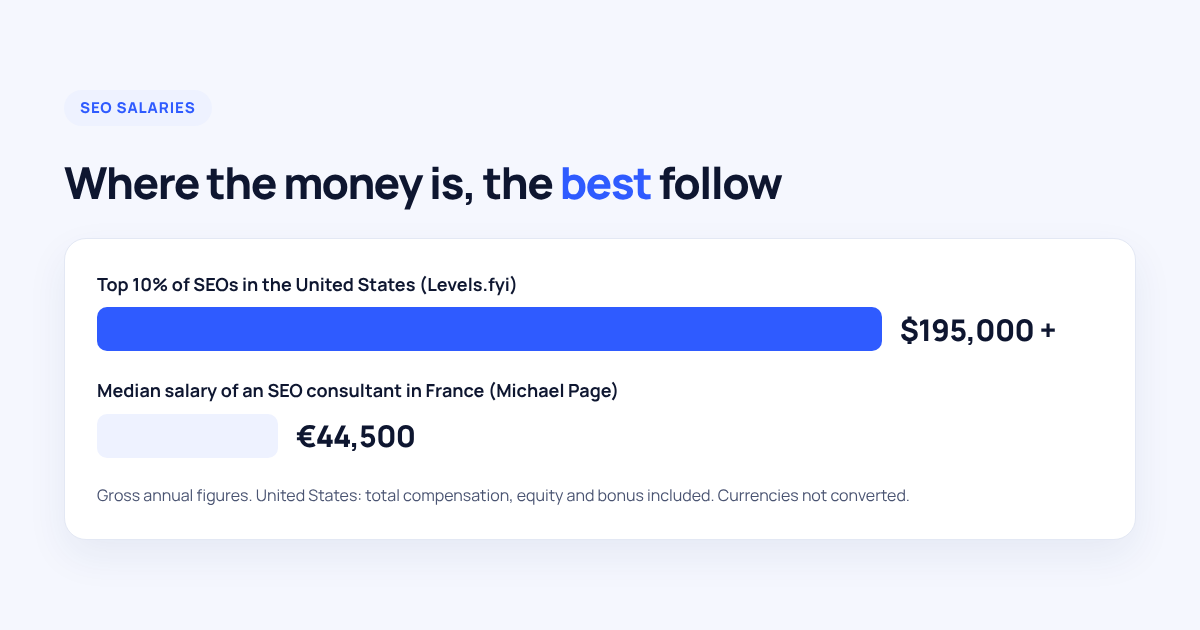 Top 10% of SEOs in the United States versus the median SEO consultant salary in France
In other words: a consultant who has proven themselves on a competitive SaaS or e-commerce site has already passed a serious filter. An "expert" who has only ever worked on neighborhood bakeries, much less so.
The red flags that should alert you
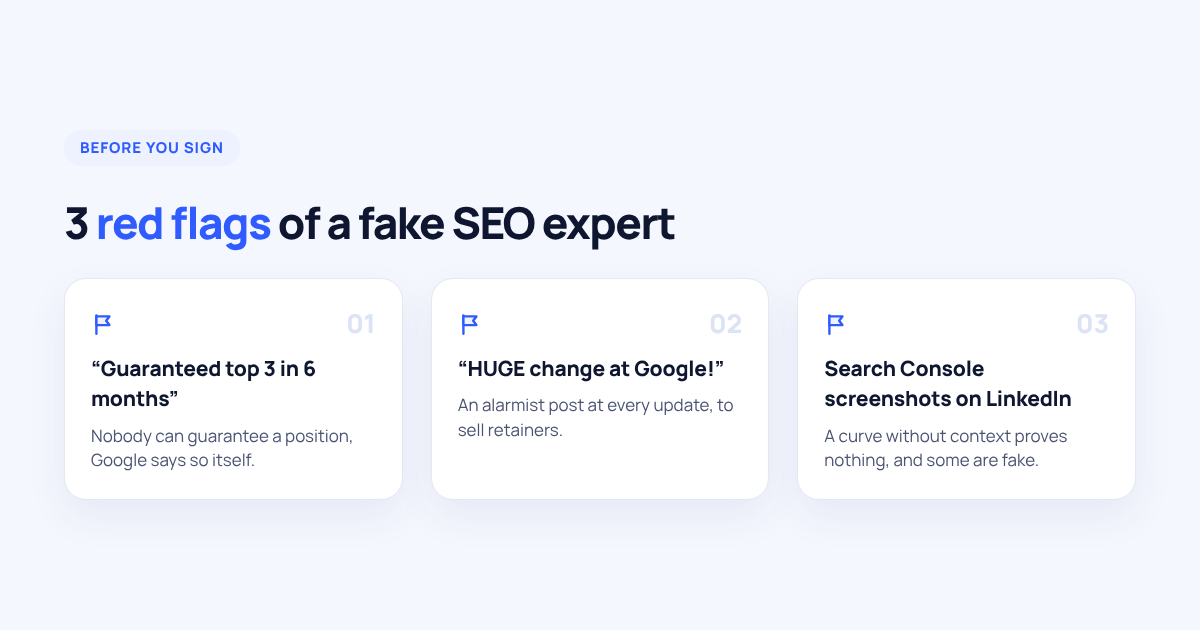 The 3 signs that should make you walk away before you sign
1. They promise you a specific ranking
"Top 3 for this query in six months." If you hear that, run. In SEO, nobody controls the final result: Google adjusts its algorithm constantly, your competitors move too, and the results page itself changes.
It is not me saying it, it is Google. Its own documentation puts it in black and white:
"No one can guarantee a #1 ranking on Google."
A good SEO promises you a method, priorities and follow-up. Not a ranking.
2. They announce an earthquake at every Google update
You have surely seen it on LinkedIn: "HUGE change at Google, all of SEO is about to be turned upside down!" In reality, it is often a minor update nobody would have noticed without that post.
Google changes its search engine all the time, and most of these changes go unnoticed. Major updates, like the core update launched on November 10, 2026, are announced on the Google Search Status Dashboard. A real expert checks there before crying wolf.
This kind of post is not there to inform you. It is there to scare you, the better to sell you coaching.
3. They show off Search Console screenshots on LinkedIn
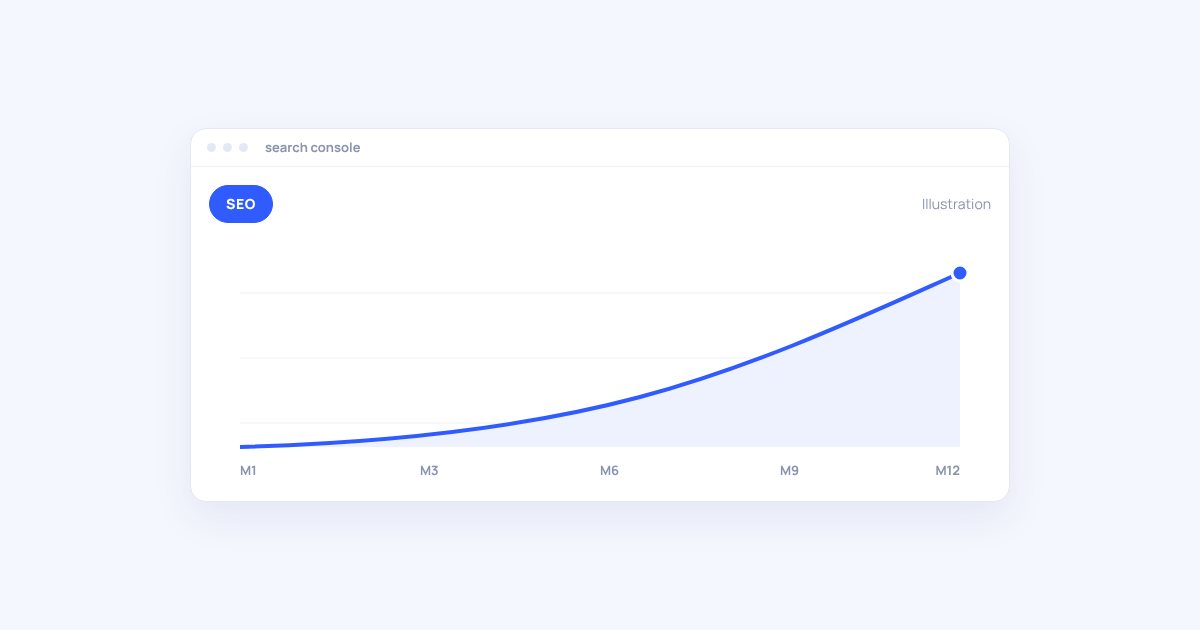
"Look what I did for this client", followed by a Search Console screenshot with a climbing curve. A classic.
First problem: a curve without context proves nothing. You know neither the period, nor the site, nor whether the growth comes from SEO, seasonality or a rise in branded searches.
Second problem: some of these screenshots are fake. I have spent so many hours in this tool that I spot edited ones at first glance: the wrong font, rounded corners that do not match the interface...
And even when they are real, ask yourself: would you like to see your own data posted on LinkedIn tomorrow?
How to check before you sign
A few simple questions are often enough to sort things out:
- Ask for a verifiable case study. A site, a period, and if possible a contact you can call. Not a screenshot.
- Ask how, not how much. A good SEO talks to you about diagnosis, priorities and timeline. An impostor talks to you about rankings.
- Ask what the monthly retainer covers. Which tasks, how many hours, which deliverables. If the answer is vague, the work will be too.
- Look at which sectors they have worked in. Competitive SaaS or e-commerce is a good sign. Only local work, be wary.
In short
SEO is not magic, and those who sell it as such are rarely the best. Be wary of ranking promises, alarmist posts and screenshots with no context.
A good consultant talks to you about method, agrees to show their work in detail, and never promises you what Google itself refuses to guarantee.
Got an SEO proposal and have doubts?
Send it to me, and I will tell you what I think.
Send it to me →